Braid POC — two Angular apps, one page
A working demonstration of the compat adapter: a host Angular app with SSR composes a separately built, separately deployed remote Angular app into its own page, through the Braid gateway. Neither app imports the other.
node tools/braid-poc/run.mjsThen open http://localhost:4500/billing/invoices.
If the words below are new — fragment, realm, slot, piercing, those /__braid/ URLs in the network tab — read Braid, explained first. It covers what each one is and why it exists, and this page will read very differently afterwards.
Requires Node 24 or newer. The gateway compiles pierce patterns with URLPattern, which is a global only from Node 23.8; the runner checks for it before building anything.
| Piece | Where | What it is | Adapter |
|---|---|---|---|
| Host | apps/braid-poc-host | Angular SSR app; its Express server mounts the gateway in front | — |
| billing | apps/braid-poc-remote | Stock Angular SPA with its own router | compat (default) |
| reviews | apps/braid-poc-react-remote | A React 19 app, built with esbuild | compat (default) |
| rating | apps/braid-poc-widget | A single custom element, no build step, no framework | custom-element |
| notifications | apps/braid-poc-notifications | Angular app with its own SSR, unbound from the host router | compat (default) |
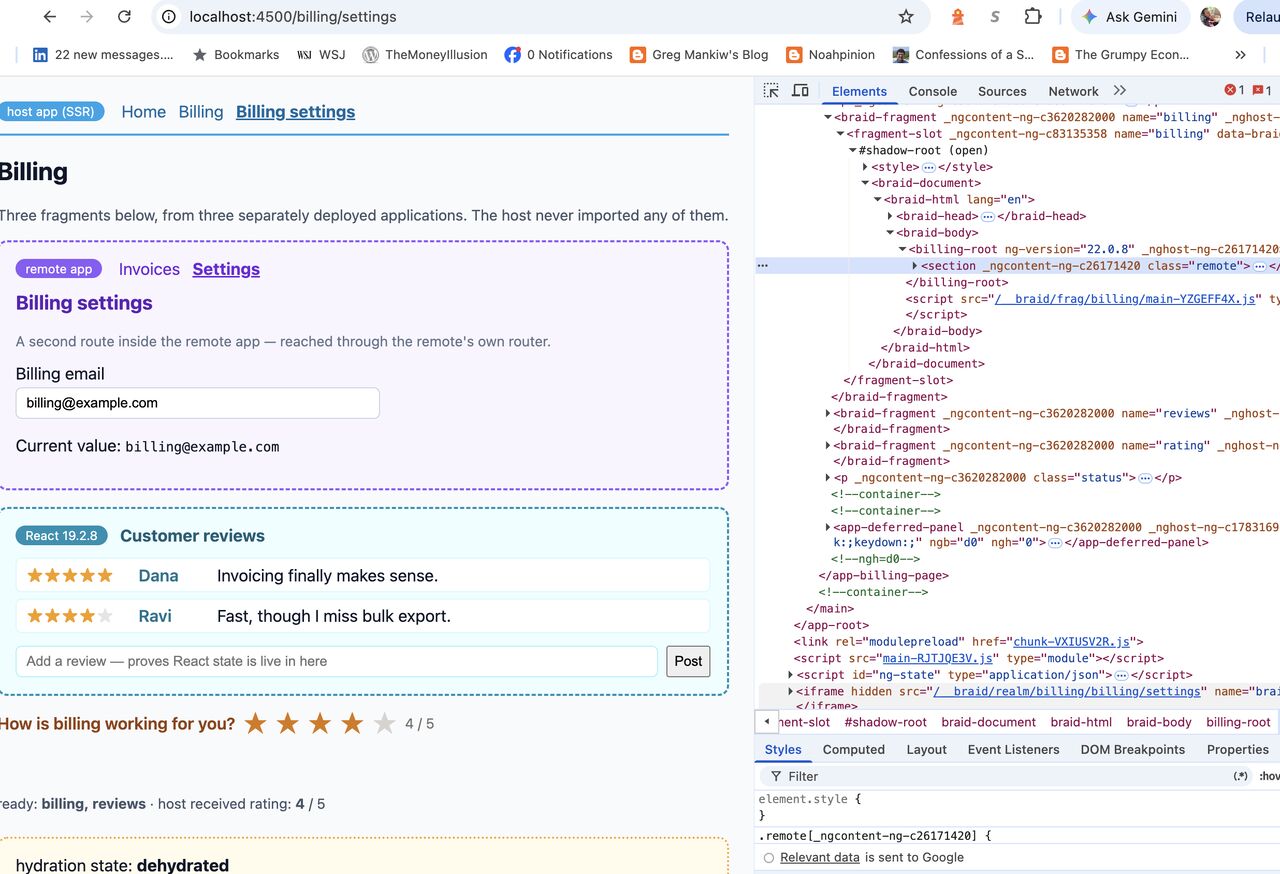
Three frameworks on one page. Angular hosts, Angular and React fragments render inside it, and a framework-free web component sits beside them — none of them imported by the host, each in its own realm with its own dependency graph.
And one of them is chrome, not a screen. The notifications panel in the header is a separately deployed Angular app with its own server-side rendering, composed into every page — see Unbound fragments below.
Unbound fragments: chrome rather than a screen
The billing fragment is a screen: it lives at /billing/*, follows host navigation, and is fetched at whatever path the user is on. The notifications panel is chrome: it appears on every page, has no relationship to the host's URL, and its content lives at exactly one address.
That distinction is two fields in the manifest:
{
  "id": "notifications",
  "endpoint": "http://localhost:4505",
  "bound": false,        // does not participate in host navigation
  "src": "/panel",       // where its content lives — fetched instead of the page path
  "pierce": ["/", "/*"], // appears on every page
  "timeoutMs": 400,
  "fallback": "placeholder"
}
and one attribute in the host's template:
<fragment-slot name="notifications" src="/panel"></fragment-slot>The path is declared in both places on purpose. The slot is what tells the client where to boot the fragment, so writing it in the template makes an unbound fragment's mount path visible in the host's own markup and identical whether or not the page was pierced — no metadata round trip, and no dependence on pierce patterns happening to cover every route. The gateway fills the attribute in when a template omits it, and warns when the two disagree, so the duplication cannot drift silently.
Both sides render on the server, per request. A curl of the host's / contains the panel's rows — Invoice 4821 was paid, 3 unread — already inside the slot's declarative shadow root. Ask the notifications origin for /billing/invoices directly and you get nothing: that path matches no route there. The rows appearing on a host page whose own path is /billing/invoices are the proof that the gateway asked for /panel.
Angular hydrates inside the realm. This was the open question the POC existed to answer. The fragment's own Angular boots in its realm and hydrates against DOM living in the host's shadow root, reached through the compat document facade — cleanly, with no NG0500-series errors, and with incremental hydration intact: a @defer (hydrate on interaction) block inside the fragment stays server-rendered and dehydrated until someone uses it.
Every page pays for it, so the budget is tight. With pierce: ['/*'], the widget's fetch is on the critical path of every document request. Against a deliberately slowed origin (2s) the host's / returned in 407ms — the 400ms budget — with the slot marked data-braid-fallback="placeholder" and the client left to boot the fragment itself. With the origin stopped entirely, / returned in 8ms, complete, and the billing page still composed its own three fragments. A widget that is down or slow costs its own absence, and nothing else.
The demo page
http://localhost:4500/demo — panels that each make one claim, offer one control, and show their own proof. The evidence is rendered in the panel on purpose: "open devtools and check the network tab" is homework, not a demonstration.
| Act | Panels | What is claimed |
|---|---|---|
| Composition | 1–3 | three apps, none importing the others; typing in one appears in another; neither can see the other's globals |
| Shared data | 4–7 | two apps fetched a record once between them; a rename in one refreshes the other; an edit shows before it is sent, and a server that disagrees says so |
| Offline and durability | 8–11 | queued work survives going offline, survives a reload, is flushed by exactly one tab, and is never taken by another app |
| Skew | 12–13 | one record on disk read at two contract versions, the older reader reporting what it could not carry |
Panel 9 is the one that earns persistOutbox: true. It runs two outboxes side by side that differ in exactly one variable — the driver — queues the same mutation into both, and asks you to reload. The persisted queue still lists its entries; the in-memory one reads 0 queued. That zero is a user's edit, gone after the UI said it saved, which is a claim worth showing rather than asserting.
Panels 6 and 7 are one mechanism seen twice. "Your edit shows instantly. The server takes two seconds" is the optimistic overlay: the queued entry carries what it predicts, every reader derives confirmed ⊕ pending from shared storage, and rolling back is deleting the entry — so the queue and the overlay cannot drift apart, because they are the same records. "The server disagreed with your edit, so we told you" is what happens when the prediction does not hold. The stored record becomes the server's value either way; onConflict: 'raise' is the default because the alternative edits the screen under someone who just typed something.
Panel 14 is the other half of the skew story, and the one people assume cannot work: a reader two versions behind, with no way back. The v3 step declares no down, so nothing can project its records down — which is exactly what a retired version looks like from below. The reader does not discard the record as corrupt and does not guess at fields the writer never sent. It reports ahead and asks the server for a version it understands, and the panel counts that request.
Panel 12 is the one nothing else can show: Luke Skywalker · Tatooine beside Luke Skywalker · Tatooine — projected down from v2, dropped starships, from a single stored record read through two chains.
Panel 2 is worth labelling precisely: it is cross-realm reactive state, not a network feature. The host writes a prop, the adapter structured-clones it across the realm boundary, and the other app renders it. Nothing leaves the page.
Reads come from SWAPI — a real third-party API, which is the point when the claim is about a shared fetch — and writes go to a mock on the host with latency, failure, and offline switches, because an outbox demonstrates nothing against a server that always succeeds instantly. DEMO_FIXTURES=1 serves committed copies when the network is unavailable.
Panel 14 — a reader too far behind to project, refetching rather than guessing — is the one act four still lacks; see the demo plan.
What the POC actually proves
The remote is a normal Angular app. Look at apps/braid-poc-remote — no Braid import, no adapter, no build plugin, no awareness of being embedded. It uses provideRouter, routerLink, and signal() exactly as it would standalone. Its manifest entry declares no adapter, so it gets compat, which is the default.
The composition is server-rendered. A document request to /billing/invoices returns one response containing the host's SSR output with the remote's markup already inside the slot as a declarative shadow root. curl it and read the HTML — the remote's <billing-root> is there, its scripts are type="inert", and its styles.css has been re-rooted to /__braid/frag/billing/styles-*.css. The client adopts that markup instead of fetching it.
Routing works in every direction, with one realm throughout:
| Navigation | Result |
|---|---|
Host router → /billing/settings | fragment switches to its Settings route |
Fragment routerLink → /billing/… | host URL changes, host nav highlights update |
| Browser back / forward | both stay in sync, natively via popstate |
The host page stays pristine. Node.prototype and the History API are untouched; each remote's globals stay in its own realm. Verified on the composed page: window.React is undefined in the host, and star-rating is defined in the fragment's custom element registry and not the host's — yet the upgraded element lives in the host's DOM. That is how the custom-element adapter works: the element is created in the realm, where it upgrades against the fragment's own definition, then moved into the host page, which preserves its class.
A web component's events cross the boundary. Clicking a star in the widget dispatches its own rating:change, which the adapter republishes as a braid:event, which the Angular host receives as a typed output and writes into a signal. Props go the other way as element properties.
Incremental hydration coexists with fragments. The billing page also carries a @defer (hydrate on interaction) block. It is server-rendered but dehydrated; its JavaScript chunk downloads only when you click it, then it hydrates and the triggering click is replayed — on the same page where a fragment boots into its own realm. Neither mechanism disturbs the other.
The gateway publishes its registry. GET /__braid/registry lists the composable apps. The POC runs in development mode, so it returns everything including internal endpoints; see the gateway README for how roles, permissions, and pagination work in production.
The registry console runs alongside it, at http://localhost:4500/__braid/console/ — the same origin as the gateway, which is why it needs no CORS, no second deployment, and no separate session. It reads /__braid/registry and writes to /__braid/registry-api, and the POC mounts both.
Publishing there writes an immutable snapshot to .braid/registry. Note the gap the POC leaves deliberately visible: this gateway serves the inline manifests in server.ts, so a published snapshot changes nothing until a deploy pins its id. That is the model rather than a shortcoming of the demo — configuration changes are deploys, which is what makes rollback a pointer move. See @braidlabs/registry.
The host's entire integration
The host uses @braidlabs/angular, so the integration is one provider and one element:
// main.ts
providers: [...appConfig.providers, provideBraid({ dev: true })];<!-- billing-page.ts -->
<braid-fragment name="billing" (ready)="onReady($event)" />Plus the gateway registration in server.ts. That is the complete cost of hosting a fragment.
provideBraid() handles the router wiring that bound fragments need — subscribing to NavigationEnd/NavigationSkipped rather than every router event, which is the difference between a fragment that follows the host and one that lags a navigation behind. The component keeps the page's templates strictly checked (no CUSTOM_ELEMENTS_SCHEMA) and turns braid:ready/braid:error into typed outputs.
Two things worth knowing
Use an after-navigation hook, not every router event. NavigationStart fires before the URL changes; notifying then reports a location the page hasn't reached. The bus now tolerates this (it keys duplicate-suppression on the URL, not on time alone), but filtering to NavigationEnd is the correct wiring.
Hydration is load-bearing. Without provideClientHydration() on both bootstraps, Angular discards the server-rendered DOM and re-creates it — destroying the slot the gateway just filled and booting a second realm to fetch the fragment again. With hydration there is exactly one realm, and the pierced content is what you see.
State note: navigating away from a fragment route and back re-creates the remote's routed component, so component-level state resets — the same thing that happens in the remote standalone. The realm and the application inside it are never rebooted.